
In 2026, a Community Health Assistant (CHA) in Kenya typically earns between about KSh 26,900 and KSh 70,000 per month, depending mainly on employer, county, experience, and qualifications. The community Health assistant Professionals in Kena play a very essential role in providing critical health services benefiting many people, especially the most vulnerable in the community. Their pay ranges vary across the National and county governments, but both tend to pay closer to the lower–mid part of this band for entry-level posts, while well-funded NGOs and faith-based organisations sometimes reach the upper figures for experienced staff handling broader responsibilities.
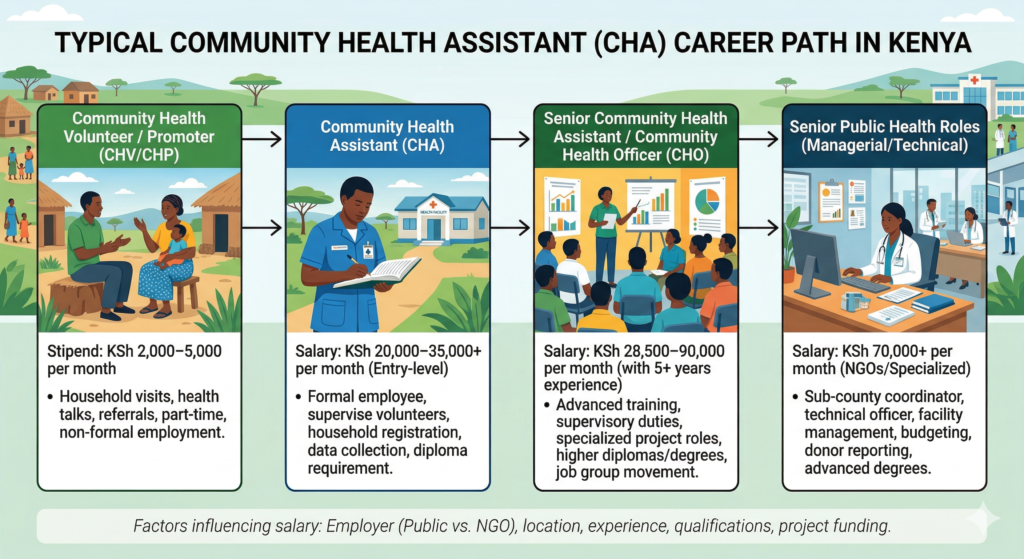
When it comes to understanding the Key roles of the Community Health Assistants, many Kenyans, and perhaps those who want to pursue this profession, still confuse them with Community Health Volunteers (CHVs) or Community Health Promoters (CHPs), who usually receive a monthly stipend of just about KSh 2,000–5,000. What you should know is that CHAs serve as a formal bridge between households and facilities, supervise volunteers, and assume legal accountability for data and referrals, which explains the higher pay and stricter educational requirements. In 2026, their role is central to Kenya’s push to strengthen the primary health system, reduce preventable deaths, and implement the community-level elements of universal health coverage. Below, I have explained their Key Roles in depth to help you understand the CHAs’ responsibilities in our society today.
Who is a Community Health Assistant in Kenya?
Before we go deeper into the specific Salary breakdown of the Community Health Assistant professionals in Kenya, it’s wise for you to perhaps understand what it means to be a CHA worker in the country. For those who might not be aware, a Community Health Assistant is a formal health worker employed by a county, national programme, NGO, or faith-based organisation to support primary health services at the household and community level.
In most cases, they usually hold at least a diploma in community health, public health, environmental health, or community health nursing, and many employers require registration with a relevant regulatory body plus a current practising licence.

Unlike Community Health Volunteers, who mainly work part‑time and receive modest stipends, CHAs are salaried, have clear job descriptions, and are accountable to facility in‑charges and sub‑county health management teams. You can often find them assigned to specific community health units, where they coordinate and supervise the work of CHVs/CHPs and report directly to the nearest link facility.
How much is a community health assistant paid in Kenya?
As mentioned previously, how much a CHA earns in Kenya varies by county, employer, and job grade; it is useful to think in bands rather than a single figure. The lowest salary a CHA in Kenya earns is KSh 20,000, but this applies only to those who haven’t applied consistently. However, most Entry-level positions attract about KSh 26,900 per month. While senior mosyts with at least 5 years of experience can clock up to KSh 90,000 per month.

Let’s break down in detail how much CHAS earns from entry-level positions to those at the top of the Salary Chain.
Entry-level Community Health Assistant salary
For a new Community Health Assistant with a fresh diploma and little or no prior experience, public employers typically place the role at an entry group that pays roughly KSh 26,900–35,000 per month.
However, their salaries aren’t fixed within the previously stated range, as some counties may still advertise slightly lower starting figures of around KSh 20,000–25,000 for contracted or project-based community roles, especially where posts are funded through local budgets or time‑bound programmes. In such cases, the contract may still allow progression to higher bands after specified years of service or upon confirmation to more permanent grades.

If you are just getting started, you need to understand that NGOs that recruit for CHA-like positions occasionally start new staff slightly above county rates when the project budget allows, but they also expect flexibility, data accuracy, and readiness to handle intensive field schedules.
Mid-level and experienced Community Health Assistant salary
Once a CHA has gained several years of experience, completed in‑service courses, and possibly taken on additional supervisory tasks, their pay typically rises into the 30,000–70,000 band, and sometimes beyond. This is mostly because their Salary progression is often linked to job group movement, annual increments, or promotion into positions such as Community Health Officer, sub‑county community focal person, or facility-based public health officer.
However, it should be noted that community health workers with 5 or more years of experience can earn in the range of about KSh 28,500–90,000, particularly if they work full-time, have additional responsibilities, or have shifted into senior community health positions. The highest figures tend to appear in specialised NGO projects, urban counties, or roles that combine technical tasks with management functions such as budgeting and donor reporting.
Also, for diploma community health nurses or public health officers serving in community-facing roles, total monthly pay can fall within the KSh 30,000–70,000 band, even for mid-level workers, rising further with seniority and additional allowances.
Public vs NGO Community Health Assistant pay
In county and national government positions, CHA salaries are anchored to official schemes of service and job groups, which set clear ranges and progression rules. This gives greater predictability: a worker knows what their basic pay will be next year and how additional training or promotion affects their pay scale. However, allowances and benefits may be relatively modest, and promotions can be slow if budgets are tight.
NGO and faith-based employers often offer packages that combine slightly higher basic pay with project-specific benefits, like transport refunds, per diems for travel, or insurance, but these roles can be time‑bound to the life of the project. When funding cycles end, staff may need to transition to new projects or seek roles in other organisations, which introduces some uncertainty despite the better short‑term compensation.
Allowances and benefits
Beyond the basic salary, Community Health Assistants can receive several types of allowances depending on the employer and job group. Common examples include commuter or transport allowances, house allowances, and, sometimes, risk or hardship allowances for staff posted to remote or high‑burden areas.
NGOs frequently reimburse field transport costs, pay daily subsistence allowances during trainings and outreaches, and provide medical coverage or group insurance for staff. While these amounts may not always be listed separately in adverts, they can significantly increase effective monthly earnings for CHAs who spend many days in the field.
In the public sector, allowances are usually standardised by job group and location, which means workers in urban centres might see different combinations than colleagues in rural hardship postings. Understanding the full package, basic pay plus benefits, helps a CHA compare offers across employers more accurately.
What work does a community health assistant do?
Community health assistants provide various roles at the community level, which include as follows:
Direct community work
At the heart of the CHA role is direct engagement with households and individuals in a defined community unit. They register households, maintain updated family records, and identify vulnerable groups such as pregnant women, newborns, people living with chronic illness, and persons with disabilities.
In addition, they deliver health education sessions on topics such as immunisation, antenatal care, nutrition, sanitation, HIV, TB, and non-communicable diseases, both one‑on‑one and in group settings. They counsel families on recognising danger signs, encourage timely visits to facilities, and support adherence to long-term treatments, for example, for TB or hypertension.
During outreach activities, CHAs help to organise and run services such as child welfare clinics, mass deworming, or community-based screening days, often alongside nurses and clinicians from the link facility. Their presence makes it easier for facilities to reach people who might otherwise skip appointments due to distance, cost, or lack of information
Supervision of volunteers and promoters
One of the key responsibilities of Community Health Assistants is to supervise and mentor Community Health Volunteers or Promoters. During this period, CHAs help recruit and orient CHVs, assign households or villages to them, and ensure they understand basic tasks such as home visits, referral slips, and health talks.
They conduct joint household visits with CHVs to check the quality of work, provide on‑the‑job coaching, and correct gaps in knowledge or practice. When new guidelines or tools are introduced, for example, updated community registers or mobile reporting apps, the CHA is usually responsible for orienting CHVs and making sure they can use them correctly. This supervisory function is part of why employers require CHAs to have formal training and strong record‑keeping skills.
Another Key role of the Community Health Assistants, in line with the supervision of volunteers and promoters, is to collect, compile, and submit community health data to the formal health information system. Each month, they aggregate CHV registers, verify figures, and prepare summary reports that feed into facility and sub‑county statistics
They attend facility and sub‑county review meetings, where they present community-level trends, discuss priority problems like low immunisation coverage or high dropout, and help plan corrective actions. These meetings connect community observations with facility planning, ensuring that services respond to real needs.
Factors that influence Community Health Assistant pay in Kenya
Several practical factors determine where a CHA’s salary will fall within the typical 20,000–90,000 band.
- Employer type: County and national government roles use fixed pay scales, while NGOs and faith-based employers have project-specific or institutional scales that can be higher for some posts.
- County and location: Wealthier or urban counties may budget more for community health staff than counties with tighter finances, and hardship or remote postings may come with additional allowances.
- Education and professional registration: A CHA with a diploma in community health or public health, plus registration and a licence, is more likely to earn at the mid to upper range than someone on a short‑term certificate contract.
- Experience and role seniority: Years of service, supervisory duties, and participation in planning often place a worker in higher job groups or senior project titles, resulting in better pay.
- Project funding level: NGO roles funded by large grants sometimes offer stronger packages, including higher base pay, per diems, and insurance, especially for positions that involve heavy coordination and donor reporting.
Career growth for Community Health Assistants in Kenya
Community Health Assistants have multiple career development paths within Kenya’s health system. Many start as CHAs at the facility or community unit level and later move into Community Health Officer roles, sub‑county community strategy coordinators, or public health officer positions
Further education, such as higher diplomas or degrees in public health, health systems management, or community health, can open doors to more senior posts with higher pay scales and broader responsibility. Some CHAs shift to technical programmes such as TB, HIV, nutrition, or WASH within NGOs, where they become field coordinators, technical officers, or M&E staff.
Others use their experience to compete for roles in facility management, health promotion units, or planning departments at the county level. In each of these steps, salary usually increases as workers move into higher job groups or more specialised project roles that require strong skills in data use, coordination, and leadership.