

The freelancing landscape has never been more promising for Kenyan professionals targeting international markets. While I’ve previously covered how you can quickly start your freelancing career in Kenya, even with no experience, this remains achievable in 2026, despite or perhaps because of the technological revolution underway. The rise of Artificial Intelligence, which some fear will replace freelancers, actually presents unprecedented opportunities for those who choose to adopt it early and strategically.
But let’s focus on something even more specific and profitable: how to land high-paying clients on popular platforms like LinkedIn, particularly in the European Union. This isn’t just wishful thinking it’s a proven strategy backed by compelling data.
Freelancing in Kenya has experienced remarkable growth in recent years. 2026 Trends suggest that Kenya has emerged as Africa’s leading destination for freelance talent, with the country experiencing an astounding 216% surge in online freelancers over the past five years. This extraordinary growth translates to over 2.1 million remote workers now contributing to the global digital landscape as of 2026, representing nearly 5% of Kenya’s total population.
However, despite this impressive growth, only approximately 23% of Kenyan freelancers successfully secure clients in the European Union, primarily due to payment processing barriers, communication gaps, limited visibility on international platforms such as LinkedIn, and insufficient understanding of EU business practices and legal requirements.

The potential for landing high-paying EU clients remains tremendously promising when approached with the right strategy. Success requires thinking both harder and smarter at the same time. You need a comprehensive, structured approach that encompasses optimizing your LinkedIn profile for European search algorithms, crafting culturally sensitive outreach messages that resonate with EU business communication styles, ensuring GDPR compliance in your contracts and data-handling practices, and managing currency fluctuations effectively through effective financial planning tools.
If these concepts seem overwhelming, don’t worry, I’ve broken down each element in detail throughout this article to provide you with a complete roadmap for success.

Why Should You Target EU Clients in 2026?
The demand for skilled remote workers in the European Union market has reached unprecedented levels as the region continues to embrace remote work policies to boost productivity and attract global talent across various industries. This shift offers a perfect opportunity for skilled Kenyan freelancers to establish profitable international partnerships.
The financial incentives make this strategy particularly compelling. The EUR/KES exchange rate, currently trading at approximately 1 EUR = 152 KES as of February 2026, is projected to remain favorable for East African freelancers. This exchange rate advantage means that even moderate project rates in Euros translate to substantial earnings when converted to Kenyan currency, allowing freelancers to build significant financial stability while working with international standards.
Beyond immediate financial benefits, the European market offers proven sustainability advantages. EU clients typically offer more consistent project flows, longer-term partnerships, and higher budget allocations than many other markets. This consistency helps eliminate the feast-or-famine cycles that plague many freelancers, creating a more predictable income stream that supports better business planning and personal financial security.

The success of this talent exchange is already demonstrated by existing partnerships between Kenya and European organizations. The Microsoft African Development Centre (ADC) in Nairobi, which opened in 2019, exemplifies this potential. The center currently employs over 100 full-time engineers and coordinates with more than 500 engineers on global projects, generating approximately €18 million in annual revenue. This demonstrates conclusively how African talent, particularly from Kenya, is increasingly valued in global technology ecosystems and broader European business markets.
Current demographic shifts in Europe further amplify these opportunities. Many European Union countries face critical talent shortages in key sectors, including artificial intelligence, software engineering, digital marketing, content creation, and specialized consulting services. These shortages are driving EU companies to actively seek remote talent from emerging markets like Kenya, where skilled professionals offer competitive expertise at favorable rate structures.
Additionally, the European Union’s progressive remote work policies, accelerated by post-pandemic workplace transformations, have made international remote partnerships not just acceptable but strategically preferred by many organizations. This policy environment creates an ideal landscape for Kenyan freelancers to establish long-term, high-value client relationships.
Crafting a LinkedIn Profile That Wins EU Clients
Securing clients on LinkedIn who convert into long-term, high-paying partnerships requires strategic investment in your profile optimization. Your profile functions as far more than a digital presence—it serves as your comprehensive professional showcase, demonstrating your expertise, presenting your work portfolio, and building essential trust with discerning European clients who often have sophisticated expectations for professional presentation.
The European business market tends to value detailed professionalism, clear communication of expertise, and evidence-based results. Understanding this cultural preference will guide every aspect of your profile optimization strategy.
Step 1: Start With Creating A Compelling Professional Headline
Your LinkedIn headline carries disproportionate importance in the European market, where business professionals often make rapid initial assessments based on clear, professional communication. This headline represents the first impression potential EU clients receive when encountering your profile, and it can definitely determine whether they investigate further or move to the next candidate.
Rather than using generic titles like “Content Writer” or “Graphic Designer,” focus on creating keyword-rich phrases that immediately communicate your specific expertise and quantifiable achievements. European clients particularly appreciate precision and measurable results in professional communications.
Here’s an example of how to transform a basic headline into a client-attracting statement:
Instead of: “Freelance Content Writer” Use: “SEO Content Strategist | Specialized in B2B SaaS Marketing | Increased Client Organic Traffic by 150% on Average”
When crafting your headline, ensure it incorporates these essential elements:
Your headline should tell your professional story in a concise, compelling manner without overwhelming the reader with unnecessary details. European business culture values efficiency and clarity in communication, so brevity combined with impact works exceptionally well.
Clearly highlight your primary area of expertise and core skills using terminology that European businesses commonly use when searching for freelance services. Research industry-specific language used in your target EU countries to ensure your headline resonates with local business communication patterns.
Include specific achievements or metrics that demonstrate your tangible impact on previous projects or clients. European businesses often make data-driven decisions, so quantifiable results significantly enhance your credibility and appeal.
While not mandatory, subtly incorporating your professional values or approach can help differentiate you from competitors, particularly when those values align with European business ethics such as sustainability, transparency, or innovation.
Step 2: Portfolio Presentation That Demonstrates European Market Understanding
In the competitive freelancing landscape, particularly when targeting sophisticated European markets, a strategically curated portfolio often carries more influence in winning clients than even the most perfectly crafted headline. Your portfolio provides concrete, indisputable evidence of your capabilities, giving potential EU clients the proof they need to make confident hiring decisions.
European clients typically prefer working with freelancers who can substantiate their claims with tangible results and demonstrate understanding of international business standards. Your portfolio should reflect this preference for evidence-based decision making.
When developing your LinkedIn portfolio, ensure these critical elements stand out prominently:
- Visual Presentation Excellence: European business culture highly values professional presentation and attention to detail. Use high-quality images, professional videos, or polished presentations to effectively illustrate your projects. For instance, if you’re a content writer targeting EU clients, your portfolio might feature well-designed case study presentations showing before-and-after metrics from your content campaigns, screenshots of published articles on recognizable European business publications, or professional videos where you explain your strategic approach to content marketing challenges.
- Achievement-Focused Results: Showcase your past successes with a specific focus on results that resonate with European business priorities. This isn’t simply about listing what you accomplished, but about demonstrating outcomes that align with typical EU business objectives, such as efficiency improvements, cost reductions, compliance achievements, or market expansion.
- Rich Media Integration: Use LinkedIn’s multimedia capabilities to incorporate videos, detailed PDFs, interactive presentations, or comprehensive case studies that provide deeper insights into your work processes and results. European clients often appreciate thorough documentation and transparent work methodologies.
- Relevant Certifications and Professional Credentials: Display globally recognized certifications, particularly those from European institutions or internationally respected organizations, in your “Licenses & Certifications” section. EU clients often value formal credentials and ongoing professional development.
Finally, organize your portfolio for intuitive navigation and include dedicated testimonial sections where previous clients can provide detailed recommendations. European business culture places significant emphasis on peer validation and professional references, making client testimonials particularly powerful for building trust with prospective EU clients.
Step 3: Social Proof Strategies for European Market Credibility
Building trust with potential European clients requires understanding their cultural approach to business relationships, which often emphasizes long-term partnerships, professional reliability, and peer validation. Social proof is a powerful tool for quickly and effectively establishing credibility, as it validates your expertise through third-party endorsements rather than self-promotion.
European business culture typically values peer recommendations, professional references, and evidence of successful collaborative relationships. Leveraging these preferences strategically can significantly accelerate your client acquisition process.
The most effective approach is to secure detailed testimonials from any previous EU clients you have worked with, even on smaller projects. Reach out to these past clients with a professional request for feedback on your services, and when they express satisfaction, ask them to provide a specific testimonial highlighting the results you achieved and the quality of your professional collaboration. European businesses often trust peer recommendations more than marketing claims, making these testimonials exceptionally valuable.
Additionally, engage strategically with European business influencers and thought leaders in your industry. This doesn’t require complex networking; focus on authentic interactions through commenting thoughtfully on their LinkedIn posts, sharing their relevant content with your own professional insights, and occasionally participating in industry discussions where you can contribute valuable perspectives. These interactions gradually build your visibility within European professional networks.
Perhaps most importantly, maintain ongoing relationships with your past clients through periodic check-ins and professional updates. This relationship maintenance serves multiple purposes: it demonstrates your commitment to long-term professional relationships (highly valued in European business culture), encourages clients to provide LinkedIn recommendations or endorsements, and often leads to repeat business or referrals to their professional networks.
European businesses often operate within interconnected professional communities, making reputation and word-of-mouth recommendations particularly influential for securing new opportunities.
How to Structure Cold Outreach That Converts EU Clients
Now that you’ve optimized your LinkedIn profile to attract high-paying European clients, it’s time to adopt a more proactive approach to client acquisition. Even with a perfectly optimized profile, consistent success often requires strategic direct outreach to potential clients. This is where culturally informed cold outreach becomes essential for penetrating the European market.
The success of your cold outreach to European clients depends heavily on your ability to create personalized, culturally aligned messages that demonstrate understanding of European business communication styles and priorities. Your outreach messages should capture attention, show genuine empathy for the client’s challenges, offer concrete solutions, and include clear, professional calls to action.
European business communication tends to be more formal and detailed than in some other markets, with an appreciation for thorough research and professional courtesy. Your outreach should reflect these cultural preferences while maintaining authenticity and personal connection.
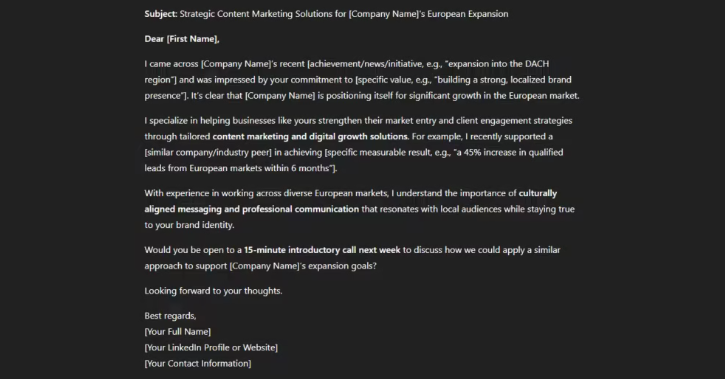
Here’s an effective template structure for EU client outreach:
- Subject Line: Keep it professional and specific, such as “Strategic Content Marketing Solutions for [Company Name]’s European Expansion.”
- Opening: Reference something specific about their company, recent achievement, or industry challenge that demonstrates you’ve researched their business thoughtfully.
- Value Proposition: Clearly articulate how your specific expertise addresses a challenge they likely face, with reference to similar results you’ve achieved for other clients.
- Social Proof: Briefly mention a relevant success story or credential that establishes your credibility in their industry or region.
- Call to Action: Suggest a specific, low-commitment next step, such as a brief conversation to explore potential collaboration.
- Professional Closing: Use formal but friendly sign-offs appropriate for European business communication.
If you find creating effective cold outreach templates challenging, you can leverage AI tools like ChatGPT or Claude to generate initial drafts based on your specific goals and target audience characteristics. However, always customize these generated templates significantly to add your personal voice and specific research about each prospect before sending.
Additionally, consider timing factors carefully. Since you’re operating from Kenya, ensure you send outreach messages during Central European Time (CET) working hours when EU clients are most likely to check their professional communications. This typically means late afternoon or early evening in Kenyan time, depending on the season.
Measuring and Optimizing Your EU Client Acquisition Strategy
Successful freelancers treat their client acquisition efforts as a systematic business process that can be measured, analyzed, and continuously improved. This data-driven approach is particularly important when targeting European clients, who often appreciate professional business practices and systematic approaches.
Track key performance indicators, including your LinkedIn profile view rates, connection request acceptance rates, outreach message response rates, and ultimately, your conversion from initial contact to paid projects. Identify patterns in your most successful client acquisitions to refine and replicate effective strategies.
Regularly analyze which types of content, outreach approaches, and engagement strategies generate the best results with European prospects. Use this data to focus your time and energy on the highest-impact activities while eliminating or improving less effective tactics.
Consider conducting quarterly reviews of your EU client acquisition strategy and adjusting your approach based on market changes, seasonal variations in European business activity, and evolving LinkedIn platform features.
How to get foreign clients on LinkedIn?
Optimize your LinkedIn profile with a niche-specific headline, quantified results, and language signals (e.g., “English & French”). Use LinkedIn Sales Navigator or a Boolean search to identify decision-makers in your target countries. Send personalized connection requests that mention a specific post or company achievement, then follow up with a value-focused message that offers a case study or a free audit. Publish weekly thought leadership content in your niche to build visibility with international audiences.
How to get freelance clients through LinkedIn?
Start by positioning your profile as a service storefront: a clear headline stating who you help and how, an About section with problem-solution-proof structure, and a Featured section showcasing case studies and testimonials. Engage authentically by commenting on prospects’ posts before reaching out. Use the 3-part outreach framework: a personalized hook, a value bridge with specific outcomes, and a low-friction ask. Track metrics (connection acceptance rate, reply rate, discovery calls) and optimize based on what converts.
Which site is better for freelancing?
It depends on your experience level and target market. Upwork and Fiverr work for beginners building portfolios, but have intense competition and lower rates. Toptal and Gun.io offer higher-paying clients but require rigorous vetting. LinkedIn (direct outreach) offers the highest earning potential and client quality if you master prospecting, because you bypass platform fees and compete on expertise rather than price. For Kenyan freelancers targeting premium markets, LinkedIn direct outreach to EU/US clients typically outperforms bid-based platforms.
What is the 5 3 2 rule on LinkedIn?
The 5-3-2 rule is a content-sharing guideline: for every 10 posts you share, use 5 pieces of curated content from others (articles, insights), 3 pieces of original content created by you (articles, case studies, lessons learned), and 2 fun/personal posts (hobbies, behind-the-scenes, celebrations). This keeps your feed balanced between value-sharing, expertise-building, and authentic human connection—critical for building trust with potential clients.
What is the 95-5 rule on LinkedIn?
The 95-5 rule states that at any given time, only 5% of your target market is actively looking to buy, while 95% are not in-market yet. This means most of your LinkedIn outreach will not convert immediately. The strategy: focus on long-term visibility and nurture. Publish helpful content consistently, engage authentically, and stay top-of-mind so that when prospects enter the buying window (the 5%), they think of you first. Don’t give up after one cold message—stay visible for months.
Conclusion
And there you have it—a comprehensive guide to securing high-paying EU clients as a Kenyan freelancer in 2026. If you still can’t crack it at this point, just remember that success in this competitive market comes down to three key pillars we’ve explored: niche specialization to stand out, strategic LinkedIn optimization to showcase your expertise, and culturally aligned outreach that resonates with European clients.
Remember that persistence is key—building relationships with EU clients takes time and consistent effort. Start by implementing one strategy at a time, measuring what works for your specific situation, and continuously refining your approach.
Hey, what do you think about the article? I would love to see your opinions in the comments below.