

Every year, thousands of Form Four students across Kenya prepare to sit for the Kenya Certificate of Secondary Education (KCSE), a critical examination that determines their academic and career trajectories. For the 2026 examination cycle, the Kenya National Examinations Council (KNEC) has opened registration, requiring all schools and candidates to meet specific requirements and deadlines to ensure a smooth participation.
In the past, I have covered the Full KCSE timetable for the upcoming national exams. However, I also believe it is important to know how you, as a candidate or a school, can ensure that all your students are registered for this important exam, which enables them to transition to the next phase of their academic journey. The registration process requires that all students and examination centres are aware of the compliance requirements for their respective parties to ensure a smooth registration.
Who Can Register? Eligibility Criteria Explained
Although many, especially the candidates involved, might not know about what goes on behind the scenes of the KCSE registration process, there are quite a lot of requirements that you must meet or even your examination centre before KNEC fully processes any candidate registration for the KCSE exams. Below is a complete breakdown of who can register for the KCSE exams, along with the eligibility criteria:
Regular Candidates
These are categories of students found in registered public and private schools nationwide. Exam registration is done by the school principal rather than the candidates themselves. However, there are still key requirements that you must meet, which are as follows:

- You must be genuinely eligible for the exam. KNEC strictly prohibits the registration of “ghost candidates,” and any found guilty of this can face severe penalties, including the de-registration of the school.
- You need to adhere to KNEC’s subject entry requirements regarding grading (subject clusters) as outlined in the KNEC Rules and Regulations (2015).
- During registration, you must provide a correct passport-size photograph (300 x 300 pixels). Remember that no changes or replacements of photos will be permitted once registration closes.
- Your personal information must be 100% accurate, including:
- Correct spelling and order of your name as documented in your KCPE certificate
- Gender and year of birth
- Citizenship status
- Entry codes (indicating whether it’s your 1st, 2nd, or 3rd attempt)
- Birth certificate number
- Subjects you’re registering for
- Any special needs or disabilities (if applicable)
Private Candidates and Repeaters
These students are not enrolled in a regular school setting; rather, they must register at the Sub-County Directors of Education (SCDE) offices to sit for their exams. The registration for private candidates is open if they are full repeaters, those sitting for seven or more papers, and partial repeaters for those sitting for fewer than seven subjects. The only requirement in this case is that private candidates must provide proof of eligibility by presenting documents such as a National ID/birth certificate/passport, and then pay a registration fee of KSh. 7,200 through the E-Citizen portal.
Examination Centres
These are places where students, except for private candidates, actually have to sit their examinations. It is the work of examination centres to ensure that all students in them are registered for the exams, but before they can do that, examination centres also have to meet specific criteria, which are as follows:

- Schools with fewer than five candidates cannot register as independent examination centres; instead, they must partner with nearby approved centres.
- Examination centres with fewer than 30 candidates will be hosted at centres identified by SCDEs.
- Each sub-county will have only one private examination centre for private candidates and one public school where private candidates will undertake examination projects.
- New institutions seeking registration as KNEC examination centres must undergo inspection and submit various documents, including registration certificates, inspection questionnaires, and application fees (Ksh. 5,000 for public schools and Ksh. 15,000 for private schools).
Note
KNEC does not discriminate against who can sit for the KCSE examinations and thus caters to candidates with special disabilities. Therefore, as a school registering these candidates, you must know their specific codes to ensure the successful registration of candidates with disabilities at your exam centres.
The special category codes are as follows:
- Visually impaired candidates requiring Braille (coded as B)
- Visually impaired candidates needing Large Print papers (coded as LV)
- Candidates with hearing impairment (coded as D)
- Candidates with physical impairments (coded as P)
The registration process for all candidates must be completed within the set deadlines, with registration beginning on February 17th, 2025, and ending on March 28th, 2025. Schools Hoevwer has been given until March 31st, 2025, to submit registration documents.
KCSE KNEC Online Registration Process
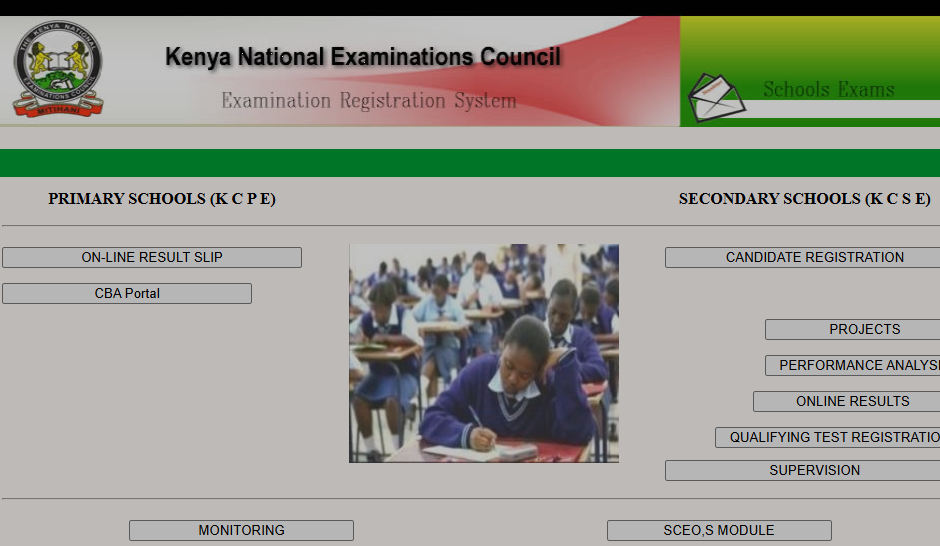
The KNEC Portal is the key to ensuring all candidates are registered for the KCSE exams. If you know how to access it, well, good for you, but if you don’t know how, below is how you can log in and begin the registration process:
- Visit the official KNEC portal at www.knec-portal.ac.ke and click on Candidate registration
- To log in, you will need your school’s centre code as the username, usually a unique 8-digit number. To obtain the password, send a text message to 22262 in the format KCSE#centrecode, and you will receive it via SMS on your phone.
- Upon first login, you will be prompted to change your password as a security measure. Ensure you follow the rest of the prompts as the system guides you.
Step-by-Step Registration Process
Once logged in, you can follow the rest of the prompts to register your candidates on time. Basically, the registration process involves a series of steps that include uploading the registration file, followed by Candidate Profile Creation, which ensures all personal details of all candidates at your examination centre, including names and dates of birth, match those on the KCPE certificate.
Additionally, depending on the type of candidature registration, all the above documents must be uploaded as required.

The second step entails Subject Selection and Validation, where school heads must ensure that the candidates’ subject choices are as per the KNEC 2015/2024 guidelines and that the entry codes for the candidates are as accurate as possible.
The last step is the submission process for the candidates, which only happens once all the details have been confirmed to be very accurate; at this stage, you must also pay the KCSE registration fee so that all the details of the candidates can now be considered successful.
Required Documents for KCSE Registration
Proper documentation is crucial for successful KCSE registration. Different candidate categories require different sets of documents to complete their registration process.
For Regular School Candidates
School principals must ensure they have the following for each candidate:
- Valid birth certificate or National ID card
- Kenya Certificate of Primary Education (KCPE) certificate with correct index number
- Recent passport-size photograph (300 x 300 pixels) with plain, light background
- Accurate personal information matching KCPE records
- Subject selection forms completed according to KNEC guidelines
For Private and Repeating Candidates
Private candidates registering through Sub-County Directors of Education offices must provide:
- National ID, passport, or birth certificate (with evidence of pending ID application if unavailable)
- KCPE certificate or KCSE Qualifying Test pass slip (for those with CPE or foreign certificates)
- KCSE result slip or certificate for repeaters
- Two recent passport-size photographs (300 x 300 pixels)
- Confirmation letter from SCDE or head teacher of approved examination centre where practical papers will be taken
- Proof of having spent at least three years since sitting KCPE (for first-time private candidates)
- School leaving certificate from previous school attended
For New Examination Centres
Institutions applying to become registered KNEC examination centres must submit:
- Certified copy of valid registration certificate from County Director of Education
- Inspection questionnaire from SCDE’s office, duly completed
- Application form properly filled by the school
- Bank deposit slip showing payment of centre registration fee (Ksh. 5,000 for public schools, Ksh. 15,000 for private schools)
All documents must be submitted within the registration period to avoid disqualification.
How Much is the Registration Fee for KCSE 2026?
The registration fee for the 2026 KCSE exams is set at KSh 7,200 for private candidates, repeaters, and other non-regular candidates. It is mandatory that the stated fee is paid to ensure successful registration for candidates.
It’s important to note that the Government of Kenya, through the Ministry of Education, pays examination fees for all first-time candidates in public and private schools except for:
- Candidates who are re-sitting/repeating the examinations
- Non-Citizens (Non-Kenyans)
- Private candidates registering in the Sub-County Private Examination Centres
The payment process must be strictly made through the E-Citizen platform. You can check this awesome guide to see how to navigate the platform, from registration to utilizing various services. Alternatively, fees can be paid at designated KNEC bank accounts including National Bank, Kenya Commercial Bank, Co-operative Bank, or Equity Bank, with deposit slips submitted to the Sub-County Director of Education.
Key Registration Deadlines for KCSE 2026
Meeting registration deadlines is critical to ensure your participation in the KCSE examinations. Missing these deadlines typically means no late registration will be accepted.
Based on KNEC’s typical examination cycle, KCSE 2026 registration is expected to follow this timeline:
- Registration Opens: Mid-February 2026
- Registration Closes: Late March 2026
- Document Submission Deadline: Usually a few days after registration closes
- SMS Verification for Parents: Expected to launch in April 2026
KNEC typically announces exact dates through official circulars posted on their website at www.knec.ac.ke. Schools, candidates, and parents should regularly check the KNEC website or contact their Sub-County Directors of Education for confirmed dates.
Note: There is no provision for late registration after the deadline passes, so ensure all documentation and payments are completed on time.
FAQs
How much is the registration fee for KCSE 2026?
The KCSE registration fee is KSh 7,200 for private candidates, repeating candidates, and non-citizens. The Government of Kenya covers examination fees for first-time candidates in both public and private schools through the Ministry of Education. Payment must be made through the E-Citizen platform or designated bank accounts.
Will there be KCSE in 2026 in Kenya?
Yes, KCSE exams will take place in 2026. According to the Ministry of Education’s official 2026 academic calendar, the Kenya Certificate of Secondary Education (KCSE) examinations are scheduled to run from Monday, November 2 to Friday, November 20, 2026. The exams will run for 19 days (approximately 3 weeks).
What grade is 45 points in KCSE?
How to access the KCSE portal?
To access the KCSE portal, visit the official KNEC portal at www.knec-portal.ac.ke and click on “Candidate Registration”. You will need your school’s centre code (an 8-digit number) as the username. To obtain the password, send an SMS to 22262 in the format: KCSE#centrecode. You will receive the password via SMS. Upon first login, you’ll be prompted to change your password for security.
Is 80 an A or a B in KCSE?
80 marks is an A (plain) in KCSE for most subjects. In English, marks between 80 and 100 constitute an A grade (12 points). However, the mark range for an A varies by subject: Mathematics requires 70-100, Geography requires 66-100, while subjects like CRE require 90-100. An 80 would be an A in English, Mathematics, and Geography, but an A- or B+ in CRE.