


“Your first blog posts won’t be perfect, but you have to start somewhere and grow from there.” — Shane Barker, ShaneBarker.com
It is easy to start a blog; it takes only 5 minutes to register a domain name and less than an hour to customize it. But do you have what it takes to drive your blog from zero to profitability? If you’re looking for a definitive guide as a beginner to help you create your first blog post in 2026, then this comprehensive article has everything you want to know. I have written this guide based on my own experiences to ensure that you succeed in your blogging career while avoiding the mistakes I made in the past.
The term blogging is new in Kenya, but blogging has been active in the country for about 15 years. Blogging is still relevant in Kenya today, not only for individuals who do it for their passion but also for businesses, as it is a powerful tool that can help companies succeed and improve their online presence. In fact, companies with active blogs generate 67% more qualified leads than those without blogs, and content marketing costs 62% less than traditional marketing while generating more than three times as many leads, according to recent industry research.
Word of Advice: If you want to start a blog in Kenya to make lots of pennies overnight, then trust me, you should quit the idea and focus on something else (No Offense). It takes a lot of hard work and passion to grow a blog and even monetize it, so you can start seeing some revenue from your work. The blogging industry is projected to grow significantly through 2026, but success requires consistent effort and strategic planning.

Should You Start a Blog in Kenya’s Digital Economy?
Before what, who, and why? In recent years, I have met people who want to start blogs or maybe venture into article creation. The only stumbling block they face is the fear of blogging being a waste of time in Kenya, as it is not profitable due to market competition. Secondly, you need a bachelor’s or diploma in journalism to land a high-paying role in the field
Okay, it may sound true to your self-beliefs, but what if you are living in a bubble because, let’s face it, the world is changing? Education is an essential factor in employability, but skills matter most for blogging or other online work in Kenya. When I went to university, I studied Mathematics and computer science, and for the roles I have landed so far as a content writer, I don’t recall them being based on my educational certifications; it’s all about whether you have the skills and a portfolio to showcase your experience.

Similarly, you may see blogging as unprofitable if you want to make huge bucks overnight and turn your blog into a success. However, it’s just like any other business: the more you invest in it, the more you start seeing results. So why should you start a blog in Kenya? Below are 4 key reasons to consider it:
- Local Opportunities: The blogging space in Kenya is underexploited despite being competitive. Most blogs in Kenya are multi-topic and focus on many topics. In my experience, valuable blogs focus on a specific area, giving you a chance to become an expert in that niche, which can lead to many opportunities and recognition. The Kenyan economy is projected to grow at 4.9% to 5.2% in 2026, creating expanding opportunities for digital entrepreneurs.
- Global Relevance: With Kenya positioning itself as the Silicon Savannah of Africa, blogging presents an opportunity to make your voice heard locally and globally. A good example of a blog that has pulled this off is Techweez.com, a go-to platform for all things technology. Your content can reach both the local audience and international readers interested in African perspectives.
- Growing Digital Ecosystem: Kenya’s mobile money ecosystem, led by M-Pesa with 34 million subscribers, has created a sophisticated digital payment infrastructure that makes monetizing blogs easier than in many other African countries. With 77.5 million mobile connections (134% of the population), your audience is more connected and transaction-ready than ever.
- Make Money from Your Blog: The best part of blogging is that it allows you to earn money while working from anywhere. As your blog grows, you can monetize it through various strategies, including ad revenue, brand partnerships, affiliate marketing, and digital product sales. Successful Kenyan bloggers can earn substantial income from their blogs with consistent effort and strategic monetization.
Current Blogging Trends in Kenya for 2026
Knowing the current trends in strategy will help you position your blog for success. Based on my analysis of successful Kenyan blogs and global blogging data, here are the dominant trends shaping the industry:
- Mobile-First Content Creation: With 80.4% of mobile connections in Kenya now considered “broadband,” your content must be optimized for mobile consumption. This means shorter paragraphs, scannable content, and mobile-friendly images.
- Video Integration: Successful blogs now incorporate video content, with YouTube becoming increasingly popular in Kenya. Consider adding video explanations, tutorials, or vlogs to complement your written content.
- Local SEO Focus: Kenyan audiences increasingly search for location-specific content. Phrases like “in Kenya,” “Nairobi-based,” and “Kenyan solutions” are becoming crucial for search visibility.
- Authentic Storytelling: Readers gravitate toward genuine, experience-based content rather than generic advice. Your personal journey and local insights become competitive advantages.
How Do You Choose a Profitable Blogging Niche in 2026?
When you’re starting a blog website for the first time, one crucial factor is knowing what your blog will be talking about, not just today or tomorrow, but also in the years to come. Choosing your niche should be done wisely because it will determine your blog’s long-term success, and it can also be what will break you in the long run.

Back in the early days of blogging, one could quickly set up a website, focus on many topics, and rank higher in search results. But that is not the case today, especially in the age of generative intelligence and Google core updates. The game has been changed, and only those who niche down and show expertise in their area of focus win.
If you have an idea of what you already want your blog to focus on, good for you, but then if you are just new and feeling overwhelmed, below are five key questions that you must make sure to ask yourself to choose a profitable blogging niche in Kenya:
Is This a Topic You’re Passionate About?
The idea behind starting your blog is to make money from it, but this is where most people get it wrong, especially for those who want quick results. It takes time to nurture a blog. It’s like a baby. You cannot expect a newborn to start running, skipping the crawling and walking phase. The best way to succeed in writing a blog is to be passionate about what you write daily. The only way to be sure of that is by choosing a niche you have a genuine interest in so that you can grow your business in the many years to come.
Does Your Niche Have a Paying Audience?
When it comes to selecting an area of focus, you also need to consider your audience and how they will engage with your work. A good niche has an audience willing to pay for your service whenever needed. For example, can your audience buy from you if you start offering affiliate marketing through platforms like Jumia and Kilimall? If that’s the case for you, you are already on the path to winning.
Is There Public Interest in Your Chosen Niche?
Even if you are sure that the niche you have in mind is just the best thing for you, it will be zero work if you focus on it if it is not relevant to your audience. That’s why it is crucial to research and understand the level of public interest in what you want to blog about. How can you do that? Today, there are many free tools, such as Google Trends, that you can use to see if a topic is worth investing in. Other relevant paid tools that provide you with comprehensive data on a topic, including competitor checks, SEO analysis, and more, include Ahrefs, Ubersuggest, and Semrush.
Can Your Niche Stand the Test of Time?
Considering the longevity of your blog is another vital area to focus on. Therefore, when setting up your business for the long term, select a niche that’s not based on what’s trending but rather one that can stand the test of time. Niche areas around agriculture, technology, and lifestyle continue to evolve, ensuring your content remains relevant as you update them with new information.
If you were to do a competitor analysis today for leading websites in Kenya, such as Tuko.co.ke, you would realize that this website attracts millions of readers each month, but most of its traffic does not come from its news articles; rather, it comes from producing evergreen content.
This should be the case when selecting a niche. Avoid going for trends that last a day; instead, focus on evergreen topics that offer solutions to your audience. That way, they can continue bringing traffic to your blog without you worrying about what is trending or not.
Is There Money-Making Potential?
Monetization potential should be a key consideration when choosing your niche. Consider whether the niche allows for multiple income streams like advertising, affiliate marketing, sponsored content, digital products, or consulting services. Some niches naturally lend themselves to higher earnings due to advertiser demand and audience purchasing power.
High-Potential Blogging Niches for Kenya in 2026
Based on current market analysis and economic projections, here are the most promising niches for Kenyan bloggers:
- Fintech and Personal Finance for Youth: With M-Pesa adoption reaching 34 million subscribers and increasing financial literacy needs, this niche offers massive potential. Topics include investment apps, savings strategies, and cryptocurrency education.
- Agri-tech and Sustainable Farming: Kenya’s agricultural sector contributes 33% to GDP, and there’s growing interest in modern farming techniques, climate-smart agriculture, and agri-business opportunities.
- Health Tech and Wellness: Post-pandemic health consciousness, combined with growing middle-class wellness spending, creates opportunities for health-focused content.
- E-commerce and Side Hustles: With the rise of online shopping and gig-economy opportunities, content on starting online businesses, dropshipping, and digital marketing performs well.
- African Travel and Cultural Storytelling: Kenya’s tourism industry recovery creates opportunities for travel blogs focusing on domestic tourism, cultural heritage, and unique Kenyan experiences.
- Education Technology and Career Development: With increasing demand for online learning and skill development, educational content and career guidance blogs show strong potential.
Building a Professional Blog: Technical Setup
When you have a niche of choice, you must start planning how your ideas will come to life and be seen by your audience online. For this to be possible, you need to understand the technical aspects of setting up a blog in a professional manner. Luckily, you don’t have to have taken any coding classes. Below, I have explained every step easily to ensure you have what it takes.
Step 1: Choosing A Domain Name
A domain name, also called a blog name, is like a map that guides web visitors directly to your website homepage. A blog without a domain name is like trying to find something in the dark without any lights on. Therefore, it is essential that when you start a blog, you ideally choose a unique name people can refer to. For example, joweni.com is the domain name of my blog.
A domain name, also a blog name, is like a map that guides web visitors from the internet directly to your website homepage. A blog without a domain name is like trying to find something in the dark without any lights on. Therefore, it is essential that when you start a blog website, you ideally have a unique name that people can refer to. For example, joweni.com is the domain name of my blog.
Hosting companies provide domain names, which must be unique and not used anywhere online. You can use various domain name checker tools to determine if your name has been taken or not.
When it comes to appending domain name extensions, you have a wide range to choose from, such as (.co.ke, best for blogs targeting Kenya audience only, and .com, best for blogs targeting global audiences). Some popular domain name extensions in Kenya are:
- .ke – Best for: All entities (individuals, businesses, organizations, personal projects)
- .co.ke – Best for: Commercial entities (businesses and companies)
- .or.ke – Best for: Non-profit organizations (NGOs, charities, community groups)
- .ac.ke – Best for: Academic institutions (schools, colleges, universities)
- .go.ke – Best for: Government institutions (departments and agencies)
- .ne.ke – Best for: Network-related organizations (ISPs, telecom companies)
Step 2: Choosing A Reliable Web Hosting Company
Now that you have chosen your blog’s domain name, it is time to secure it by registering it and ensuring it can be accessed on the World Wide Web. This process involves choosing a reliable web hosting provider, as it is the company that stores all your blog’s files and makes them accessible to users whenever requested.
I would not want to go into the detailed specifics of how to choose a reliable web hosting company in Kenya. Still, over the years, Hostpinnacle has been my go-to resource for hosting websites for my clients as a software developer and even for my own websites as a blogger. You are of free will to go with whichever company works best for you, but my reasons for recommending Hostpinnacle are the following:
- Depending on your hosting plan, they offer Free .co.ke/.com/.org domains.
- They offer a one-click WordPress installation.
- They have a helpful customer service team available via web chat or phone.
- Their servers support or allow data to be stored in RAID arrays, meaning your site will never go offline and guaranteeing 99.9% Uptime.
- They use NVMe SSDs, which are 900% FASTER than Traditional SATA Drives and 200% FASTER than the latest SSD Drives. As if that’s not enough, they use the powerful LiteSpeed web server, which delivers up to 300% faster website load times.
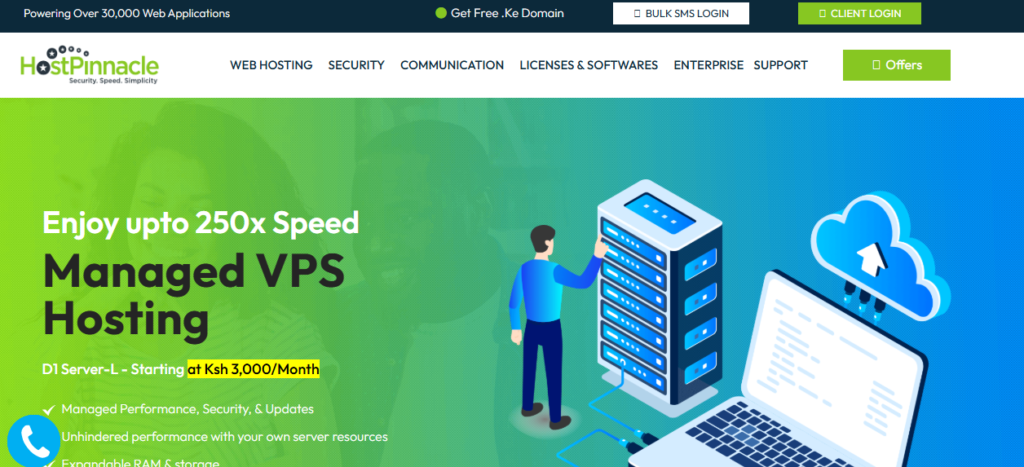
Here is how you can register and quickly set up your blog post to make sure it appears online for everyone:
- Visit Hostpinnacle at https://www.hostpinnacle.co.ke/ and search for your domain name on the main homepage.
- If the domain name is available, you will see an orange-red button marked “register now.” Click it, then add the domain to the Cart.
- Next, click checkout. On the next page (Domain Configuration), you must select a hosting plan that will allow Hostpinnacle to allocate space on their servers. Also, tick the ID protection box and click Add to Cart. NB: Hostpinnacle’s domain pricing is affordable, ranging from KES 1,200 for .co.ke domains to KES 2,200 per year for .com domains. Since you are a new blogger, I recommend you proceed with the Starter package, which usually costs KES 4,500 annually. So, when you add the starter package price and the domain price in Kenya, it costs approximately KES 5,700 to set up a website online.
- Now, back to the registration page. You are still on the same domain configuration page. Please scroll down and leave the Nameservers as they are unless you are using a domain name hosted by another web hosting company. You can change them. If not, leave them as they are and proceed.
- Proceed with the remaining prompts until you reach the checkout page. There, you must fill out your billing details and create your account password on the registration page.
- Fill in personal information as required, including your email and phone number. In the payment details section, select the PayPal options, including credit card systems. However, since we are in Kenya, using M-Pesa is easier, as payments take less than a second to go through and everything is processed. When done, press Complete Order.

Step 3: WordPress Installation
Once everything is set up, you have paid the invoice sent to your email. You need to wait less than an hour, and you will receive another email confirming that your account is set up, including your access credentials for both the server and the Hostpinnacle website.
Once everything is set up, log in to your account and choose the platform where your blog will be available. To save you time and money, I recommend proceeding with the WordPress installation, as it’s the best CMS I know that offers a range of features, from plugins to the ability to customize your website to suit your needs.
When you have logged in to the Hostpinnacle website on your Dashboard, look for the CPANEL login and click on it. You will be taken to another page where you will see many CPANEL tools. Ignore everything in there and focus on WordPress Manager by Softaculous, located in the left navigation panel.

Pay attention: When working with WordPress, there are two primary flavors you should not be confused about. One is WordPress.com, which is usually free and accessible separately, but it has many limitations, such as restricted customization. Lastly, WordPress.org provides complete control over your blog, allowing you to install themes and plugins and modify your site’s functionality to suit your needs. Luckily enough, this is what Hostpinnacle provides you with by default.
Now, let us continue with the WordPress installation: On the redirected page, Hostpinnacle has made it easier for anyone to install WordPress by guiding them through on-screen instructions. Again, in this stage, don’t be confused by the many links in the left navigation bar; focus solely on what is at the center of your dashboard (WordPress Management).
Click Install, then select your domain for the software setup from the drop-down menu. Click on Site Settings and give a name to your WordPress blog, a Site description, etc. The most important thing here is to set up the Admin username and password, as you will use them in the future to access the website. When choosing usernames, I recommend not using generic terms like Admin or your name. Use something that will make it impossible for hackers to guess the same case for passwords.
When everything is set up, scroll down to the bottom of our dashboard and click on the Install button to set your website as shown in the screenshot below:

If you have reached this point, it’s time for a mini celebration: congratulations on creating your first WordPress blog website.
Step 4: Designing Your Website
Now, it’s time to manage your blog’s design layouts, ensuring they appeal to every visitor who comes across your content. After successfully installing WordPress from the previous step, you can log in to your blog dashboard using the WordPress default WP admin URL: https://blogpost.com/wp-admin/.
Replace blogpost.com with your actual blog domain and log in to your website dashboard. Once you log in, WordPress provides quite a few useful features that are accessible from the left panel. You can take your time to go through each of them to understand what they mean. We are currently interested in the design aspect of your blog. You can make changes by navigating to the Appearance section, selecting Themes, and then adding new themes to install various WordPress themes.
For new bloggers, I recommend starting with Astra, which is best for SEO optimization and customization. It’s lightweight, loads fast, and works well with page builders like Elementor. However, you can buy a customized WordPress theme from Themeforest Marketplace.

Some of the 2025 Theme Recommendations from me are as follows:
- Astra
- GeneratePress
- Kadence
- Neve
After installing your theme of choice, you can open your website homepage in another window. Once it fully loads, click Customization to start defining your website’s layouts. These include setting your Site identity, Menus, widgets, and more.
In addition to selecting the right theme, I recommend exploring essential plugins that enhance your theme’s design and improve your website’s overall accessibility. Plugins can be accessed via the Plugin section on the left Sidebar when you have logged in to your blog’s dashboard. Some of the must-have plugins for bloggers include:
- Rank Math – This is for SEO optimization and higher search engine rankings.
- WP Rocket – For website speed improvement and caching.
- Akismet Anti-Spam – This filters out spam comments and protects your blog.
- Elementor – This is for easily designing and customizing blog pages.
- UpdraftPlus – This is for automatic website backups and quick restoration.
- WPForms – This is for creating contact forms, surveys, and lead generation forms.
- MonsterInsights – This tracks website traffic and visitor insights via Google Analytics.
- Smush – This is for compressing images and improving page load speed.
- Sucuri Security – This is for protecting your blog from malware and hacking attempts.
- Social Snap – This is for adding social media sharing buttons and increasing engagement.
How To Create Your First Blog Post
Now that everything is set up, it’s time to figure out how to make some revenue from your blog post. But hold on before that process arrives. There is a series of steps to follow that will ensure your blog is recognized, and this part involves creating your first blog post.
I wouldn’t want to teach you how to write a perfect article, but when creating your first article, you need to understand your targeted audience and the primary objective of your blog post. Your article must be clear, use an engaging headline, be well structured, optimized for SEO, readable, and visually appealing, and you can do all this with the WordPress editor.
So, how do you publish your first blog on WordPress? Below is the process to follow:
- Log in to your Blog, navigate the left menu, and click “Posts.”
- Click the “Add New Post” link to write a new post.
When you follow these two steps, you will be taken to your WordPress post editor, where you can begin writing your first post.
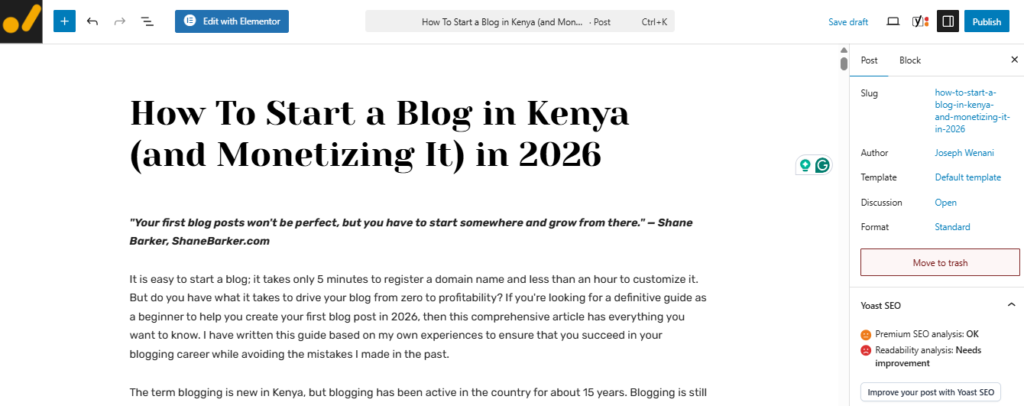
Before you publish your Post, do this:
- Make sure to proofread your work to ensure it is error-free.
- On the right side panel, you can set the featured image, the primary image your website visitors will see when they visit your blog post.
- On the same side panel, you can set your blog categories and tags that match what your article is talking about.
- If you have a plugin like Rank Math installed on your blog, scroll to the end of the article and set the Focus Keyphrase when editing your work. It should be the primary term of your article, and the meta description should be set. The Rank Math plugin also has features you can personalize, explore what makes sense in your article, and adjust accordingly.
Should You Use AI to Write Content?
When publishing your first blog post, chances are you have come across AI generative tools like ChatGPT, Google Gemini, and many others. As a new blogger, you may be tempted to use them; however, if you aim to publish content that ranks on the web, you may want to familiarize yourself with the quality ranking and spam policies.
Google is the main search engine, and many Kenyans use it daily to search for information. As a blogger, you will rely on it to ensure your website is visible online. However, for the blog to perform well in the search, you must be aware of Google’s algorithm updates, which have recently not favored websites that produce AI-generated content.
If Google is the main search engine where your blog’s content appears, then in a nutshell, here is what to understand:
- Google’s algorithms can now detect AI-generated content with 95% accuracy
- Content that provides genuine value and expertise ranks higher regardless of creation method
- The focus has shifted from “how” content is created to “what value” it provides
- E-E-A-T (Experience, Expertise, Authoritativeness, Trustworthiness) remains crucial
My Advice: If you want to use AI tools to produce content, I encourage you to proceed with caution and ensure that you edit your content to give it a human touch before publishing it, but I would advise you to only use AI tools for research, generating blog post ideas, and draft outlines, but not actual writing.
How to Submit Your Blog Post to Google Search Console
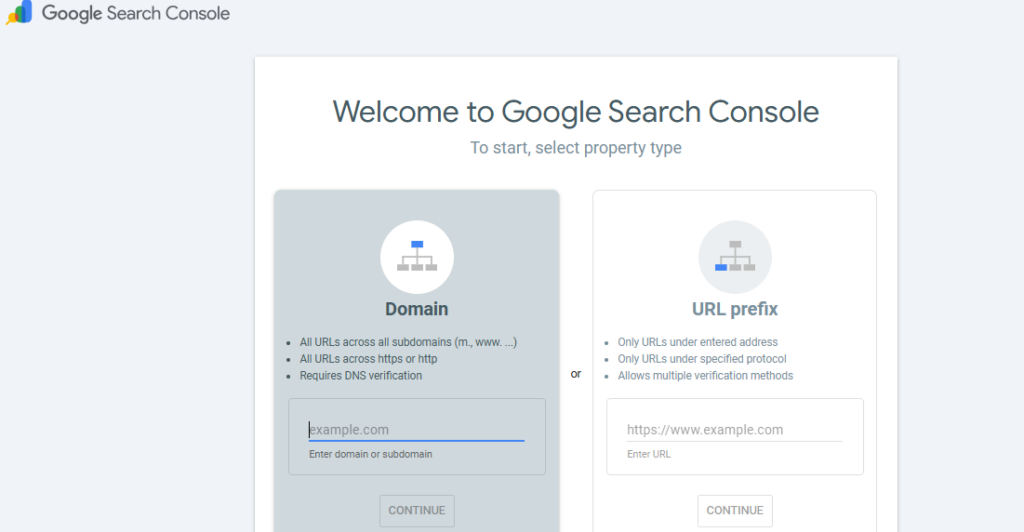
Immediately after publishing your first blog post, the best way to earn revenue from it is to know how to grow your search traffic, and the best and easiest way to do so is by ensuring that your website is accessible on the Google search engine.
This is done by adding your website to the Google Search Console (GSC), a tool that helps Google discover new content easily published on your website while also allowing you to monitor, maintain, and troubleshoot your site’s presence in Google Search results.
This step requires you to make sure your website’s sitemap is accessible. In most cases, WordPress websites are accessible by using the link https://blog.com/sitemap.xml, where blog.com is your site’s domain. Take note of your blog’s sitemap and copy and save it, as I will show you where to add it later.
Now, to add your blog to the Google search engine, follow these steps:
- Visit Google Search Console using the link https://search.google.com/search-console/welcome
- Under the URL prefix, copy your blog URL in the format https://blog.com/, paste it, and click on continue.
- Wait for the verification process, then verify your website using an appropriate method. I personally find it easier to upload an HTML file to your website’s root folder.
- When done, click verify, and you will be redirected to your GSC dashboard.
- On your GSC dashboard, submit your blog sitemap (the one I told you to copy and save earlier) by navigating to Indexing in the left-side panel, then selecting Sitemap.

Building a Loyal Audience
While submitting your blog post to GSC is the first step to ensuring that your website ranks for various search terms and even attracts organic traffic, there are a few other strategies that you can carry out to ensure your website reaches the targeted audience who will keep coming back to your blog every time as loyal readers. Below are some of the strategies you can consider:
Use Social Media Tactics
According to current data, Kenya has 15.1 million active social media users, representing 26.5% of the total population. This means one thing to any serious blogger: You can use various social media platforms to grow your website. The best social media platforms that convert for bloggers in Kenya are X (formerly Twitter), Facebook, TikTok, and WhatsApp. So long as you have a substantial following on these platforms, you can use them to direct your followers to get to know your blog and even share it with others.
Alternatively, you can use WordPress plugins such as Social Snap to automatically schedule your posts for publication on various social media platforms at different times of the day, week, etc.
Using Email Marketing
The best way to grow a loyal audience for your blog is to have your readers subscribe to your email list. In WordPress, you can use the WPForms plugin to set up a newsletter form with which your audience can interact. You can then use tools like ConvertKit, Mailchimp, or Flodesk to automate your email campaigns by notifying your site’s visitors of published posts.
To succeed in email Marketing, here are some best Practices you can personally use:
- Offer valuable lead magnets (free guides, templates, or resources)
- Send weekly newsletters with your best content
- Segment your email list based on reader interests
- Include personal stories and behind-the-scenes content
- Test different subject lines and sending times
The benefit of allowing users to register their email addresses on your website is that you can use them for email marketing, e.g., offering free and paid resources like ebooks and services to see what works best for you.
Set Up a Comment Section
A comment section is a powerful communication medium, and you should ensure it is enabled by default on your blog post articles. It allows you to have a conversation directly with your audience and, in doing so, establishes a mutual connection between you and them. As with any business model, a satisfied client will always return for more and even refer others to your business.
Reach Out to Other Bloggers
The best way to grow as a blogger in Kenya is to reach out to other bloggers you know and even offer to write for them. By doing so, you will make your voice known in the industry and give yourself a chance to be recognized and respected by other community members.
How to Monetize Your Blog & Make Money
If you have implemented the strategies we have discussed so far in the article, you are not far from understanding how blogs make money in Kenya, and this step will show you how. But before monetizing your blog, you should know that making money from a blog website doesn’t happen overnight. Honestly, I can’t stress this enough: you must be prepared to invest in the long term to earn decently from it.
It took about 2 years for me to start making money with AdSense, while a friend I know took only 6 months. How long it takes for a blog to make money varies from one website to another, and ultimately, it all narrows down to you as the blogger, but many bloggers make money within their first 3-6 months. Below are some key methods you can consider to monetize your blog in Kenya:
Advertising Revenue
Advertising revenue is earned by lending space on your website to advertisers to bid on various ads. You are paid when a user clicks on those ads. This is the most common method that almost all bloggers worldwide use as their first way to make money from their blogs.
Some platforms I have used include Google AdSense, which pays per view when an ad is viewed or clicked on your website after you have gone through their approval process. Alternatively, other platforms, such as Ezoic, work the same way as AdSense. However, the secret to earning big from advertising revenue is ensuring steady traffic to your website.
If you are just getting started with Adsense for faster approval, the Requirements for 2026 ensure that your blog features the following:
- Minimum 30 high-quality posts
- Consistent posting schedule for at least 3 months
- Clean, professional website design
- Privacy policy and terms of service pages
- Original, valuable content with proper grammar
- Minimum 1,000 monthly page views (unofficial requirement)
Brand Partnerships
The best thing about blogging is that there are many ways to earn extra cash, especially as your business grows and becomes known to many people. A good example of this is through brand partnerships. Various brands in Kenya, including phone companies and telecom houses such as Safaricom, Airtel Kenya, etc., are known for working with bloggers and paying them handsomely whenever they want you to promote a product on your platform.
Affiliate Marketing
Another popular way to earn money from your blog is through affiliate marketing. This practice allows you to promote a product by telling your readers, “Hey, if you buy this product by using this link I have provided, you will help me earn some commission whenever you make a purchase.”
Challenges You Will Face as a Blogger and How to Overcome Them
There is a reason that I had to include this section: truth be told, I would not want to sugarcoat things, but tell you openly that yes, it is easy to start a blog and be successful from it, but as a new blogger, you need to understand that there are many obstacles you will face, not one or two. Still, they will come to you, and how you handle them will determine the chances of success in the industry. While there are many challenges below, I have only highlighted the common ones and what you can do to find solutions.
Increased Competition
The blogging ecosystem in Kenya is becoming increasingly competitive, both online and offline. Every day, new websites go online, and as of the writing of this article, the Bloggers Association of Kenya has more than 2,500 registered members. Therefore, when you are just starting, you need to acknowledge the competition and strive to be unique to gain market share among the online audience.
If you are looking to be not only the best but also to increase your chances of succeeding, here are the solutions that might help you:
- Focus on micro-niches rather than broad topics
- Develop a unique voice and perspective
- Consistently produce higher-quality content than competitors
- Build genuine relationships with your audience
- Offer unique value propositions that competitors don’t provide
Monetization Challenges
When it comes to monetization, this is where most bloggers struggle to make money, and I was there, too. AdSense has become a reliable way to make money while blogging, but its approval rate in Kenya is getting harder each day, as Google only accepts blogs featuring high-quality content. Even when AdSense accepts your website, making serious money from it is not as easy as you might think; you need a significant amount of traffic.
To earn more money with your Blog, do these instead:
- Diversify income streams from day one
- Start building email lists immediately
- Create digital products early in your blogging journey
- Focus on high-value affiliate partnerships
- Develop premium content offerings
- Build direct relationships with local brands
Content Burnout and Consistency
Trust me, even with my few years of blog writing, I still experience burnout. There are days when I wake up and don’t feel like touching or even looking at my websites, but that hasn’t made me give up. While you’re growing your blog, acknowledge that it’s okay to experience burnout, but your health should always be your priority.
Some of the Burnout Prevention Strategies that have personally worked for me are as follows:
- Create content calendars and batch content creation
- Build a team of guest writers and contributors
- Use content repurposing strategies across platforms
- Take scheduled breaks without guilt
- Delegate technical tasks to freelancers
- Use automation tools for social media and email marketing
Technical and Security Challenges
With increasing cyber threats, protecting your blog is crucial. Install security plugins, keep WordPress up to date, and back up your content regularly. Additionally, ensure your site loads quickly, as mobile users expect pages to load within 3 seconds.
FAQs
Is blogging still profitable in 2026?
Yes, blogging remains highly profitable in 2026. In fact, 81% of consumers trust blog content when making purchasing decisions. However, the landscape has evolved, and successful bloggers now combine AI tools with strategic content creation, focus on multiple revenue streams, and optimize for AI search engines like ChatGPT alongside traditional Google search. AI tools have actually made blogging MORE accessible by reducing content creation time from 7-12 hours to 1-2 hours per post. Blogs that provide authentic, expert content continue to thrive.
How to create a blog in 2026?
Creating a blog in 2026 involves these key steps:
- Choose a niche with expertise and audience demand
- Register a domain (.co.ke for KES 399-1,600 or .com for KES 1,400-2,000 in Kenya)
- Purchase hosting (starting KES 2,000-10,000/year)
- Install WordPress (one-click installation available)
- Select a mobile-responsive theme (Astra, GeneratePress, Kadence)
- Install essential plugins (Yoast SEO, WP Rocket, Wordfence)
- Create cornerstone content with SEO optimization
- Build an email list from day one
- Promote consistently across social media
What is the 80/20 rule in blogging?
The 80/20 rule (Pareto Principle) in blogging states that 80% of your results come from 20% of your efforts. Specifically:
- Content vs. Promotion: Spend 20% of time creating content, 80% promoting it
- Top Posts: 20% of your blog posts generate 80% of traffic
- Revenue Sources: 20% of monetization methods produce 80% of income
- Audience Engagement: 20% of your audience generates 80% of engagement
- Time Management: Focus 20% of time on high-impact tasks, delegate the rest


